Featured Post

www.InvestorsGoldmine.com | 4/2.5 BATH, POOL, BRICK HOME, WINTER PARK, 420K | ARV 700

www.InvestorsGoldmine.com 4/2.5 BATH, POOL, BRICK HOME, WINTER PARK, 420K | ARV 700 $419,900  4 bd, 2.5 ba, 3050 sqft ...

Saturday, April 8, 2017

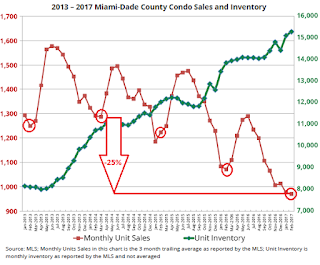
Miami Condo Glut Comes Apart: Wolf Richter on WRKO Boston

eugenehoffman.com/blog


Written by 

Wolf Richter

This is the chart I discuss in the article. Note how the two lines make a rough big “X,” with supply of condos for sale (green line, right scale) heading up and demand (sales, red line, left scale) heading down. As I said, it looks “terrible.”


Friday, April 7, 2017

Swift Gains in Fourth Quarter Push Home Prices to Peak Levels in Majority of Metro Areas | ADAM DESANCTIS


The median existing single-family home price increased in 89 percent of measured markets, with 158 out of 178 metropolitan statistical areas 1 (MSAs) showing sales price gains in the fourth quarter of 2016 compared with the fourth quarter of 2015. Twenty areas (11 percent) recorded lower median prices from a year earlier.
There were more rising markets in the fourth quarter compared to the third quarter of 2016, when price gains were recorded in 87 percent of metro areas. Thirty-one metro areas in the fourth quarter (17 percent) experienced double-digit increases — an increase from 14 percent in the third quarter.
For all of 2016, an average of 87 percent of measured markets saw increasing home prices, up from the averages in 2015 (86 percent) and 2014 (75 percent). Of the 150 markets NAR has tracked since 2005, 78 (52 percent) now have a median sales price at or above their previous all-time high.  
Lawrence Yun, NAR chief economist, says home-price gains showed little evidence of letting up through all of 2016. "Buyer interest stayed elevated in most areas thanks to mortgage rates under 4 percent for most of the year and the creation of 1.7 million new jobs edging the job market closer to full employment," he said. "At the same time, the inability for supply to catch up with this demand drove prices higher and continued to put a tight affordability squeeze on those trying to reach the market."
Added Yun, "Depressed new and existing inventory conditions led to several of the largest metro areas seeing near or above double-digit appreciation, which has pushed home values to record highs in a slight majority of markets. The exception for the most part is in the Northeast, where price growth is flatter because of healthier supply conditions."
The national median existing single-family home price in the fourth quarter of 2016 was $235,000, which is up 5.7 percent from the fourth quarter of 2015 ($222,300). The median price during the third quarter of 2016 increased 5.4 percent from the third quarter of 2015.
At the end of the fourth quarter, there were 1.65 million existing homes available for sale 2, which was 6.3 percent below the 1.76 million homes for sale at the end of the fourth quarter in 2015 and the lowest level since NAR began tracking the supply of all housing types in 1999. The average supply during the fourth quarter was 3.9 months — down from 4.6 months a year ago.
NAR President William E. Brown, a Realtor® from Alamo, California, says prospective buyers will likely see competition in their market increase even more this spring. "The prospect of higher mortgage rates and more home shoppers in coming months should be enough of an incentive for those serious about buying to start their search now," he said. "There are fewer listings on the market, but also a little less competition than what's expected this spring. Buyers may find just the home they're looking for at a good price and without the possibility of having to outbid others."
Total existing-home sales 3, including single family and condos, rose 3.3 percent to a seasonally adjusted annual rate of 5.57 million in the fourth quarter from 5.39 million in the third quarter of 2016, and are 7.1 percent higher than the 5.20 million pace during the fourth quarter of 2015.  
Despite a meaningful increase in the national family median income ($70,831) 4, rising prices and the boost in mortgage rates at the end of the year slightly weakened affordability compared to a year ago. To purchase a single-family home at the national median price, a buyer making a 5 percent down payment would need an income of $51,017, a 10 percent down payment would require an income of $48,332, and $42,962 would be needed for a 20 percent down payment.
"Even a pick-up in wage growth may be insufficient to compensate the impact of higher mortgage rates and home prices. Increased homebuilding will be crucial to alleviate supply shortages and stave off the affordability hit," added Yun.
Metro area condominium and cooperative prices — covering changes in 61 metro areas — showed the national median existing-condo price was $222,000 in the fourth quarter, up 6.1 percent from the fourth quarter of 2015 ($209,300). Nearly all metro areas (93 percent) showed gains in their median condo price from a year ago.
The five most expensive housing markets in the fourth quarter were the San Jose, California, metro area, where the median existing single-family price was $1,005,000; San Francisco, $837,500; Anaheim-Santa Ana, California, $745,200; urban Honolulu, $740,200; and San Diego, $593,000.
The five lowest-cost metro areas in the fourth quarter were Youngstown-Warren-Boardman, Ohio, $87,600; Decatur, Illinois, $92,400; Cumberland, Maryland, $94,000; Rockford, Illinois, $109,500, and Binghamton, New York, $109,700.

Regional Breakdown

Total existing-home sales in the Northeast jumped 10.5 percent in the fourth quarter and are now 6.4 percent above the fourth quarter of 2015. The median existing single-family home price in the Northeast was $254,100 in the fourth quarter, slightly lower (0.2 percent) from a year ago.   
In the Midwest, existing-home sales climbed 2.3 percent in the fourth quarter and are 8.8 percent above a year ago. The median existing single-family home price in the Midwest increased 5.7 percent to $181,100 in the fourth quarter from the same quarter a year ago.
Existing-home sales in the South increased 2.6 percent in the fourth quarter and are 5.4 percent higher than the fourth quarter of 2015. The median existing single-family home price in the South was $210,500 in the fourth quarter, 7.9 percent above a year earlier.
In the West, existing-home sales rose 1.6 percent in the fourth quarter and are 9.1 percent above a year ago. The median existing single-family home price in the West increased 7.8 percent to $348,800 in the fourth quarter from the fourth quarter of 2015.
The National Association of Realtors®, "The Voice for Real Estate," is America's largest trade association, representing over 1.1 million members involved in all aspects of the residential and commercial real estate industries.
# # #
NOTE:  NAR releases quarterly median single-family price data for approximately 175 Metropolitan Statistical Areas (MSAs). In some cases the MSA prices may not coincide with data released by state and local Realtor® associations. Any discrepancy may be due to differences in geographic coverage, product mix, and timing. In the event of discrepancies, Realtors® are advised that for business purposes, local data from their association may be more relevant.
Data tables for MSA home prices (single family and condo) are posted at https://www.nar.realtor/topics/metropolitan-median-area-prices-and-affordability. If insufficient data is reported for a MSA in particular quarter, it is listed as N/A. For areas not covered in the tables, please contact the local association of Realtors®.
Areas are generally metropolitan statistical areas as defined by the U.S. Office of Management and Budget. NAR adheres to the OMB definitions, although in some areas an exact match is not possible from the available data. A list of counties included in MSA definitions is available at: http://www.census.gov/population/estimates/metro-city/List4.txt(link is external).
Regional median home prices are from a separate sampling that includes rural areas and portions of some smaller metros that are not included in this report; the regional percentage changes do not necessarily parallel changes in the larger metro areas. The only valid comparisons for median prices are with the same period a year earlier due to seasonality in buying patterns. Quarter-to-quarter comparisons do not compensate for seasonal changes, especially for the timing of family buying patterns.
Median price measurement reflects the types of homes that are selling during the quarter and can be skewed at times by changes in the sales mix. For example, changes in the level of distressed sales, which are heavily discounted, can vary notably in given markets and may affect percentage comparisons. Annual price measures generally smooth out any quarterly swings.
NAR began tracking of metropolitan area median single-family home prices in 1979; the metro area condo price series dates back to 1989.
Because there is a concentration of condos in high-cost metro areas, the national median condo price often is higher than the median single-family price. In a given market area, condos typically cost less than single-family homes. As the reporting sample expands in the future, additional areas will be included in the condo price report.
Total inventory and month's supply data are available back through 1999, while single-family inventory and month's supply are available back to 1982 (prior to 1999, single-family sales accounted for more than 90 percent of transactions and condos were measured only on a quarterly basis).
The seasonally adjusted annual rate for a particular quarter represents what the total number of actual sales for a year would be if the relative sales pace for that quarter was maintained for four consecutive quarters. Total home sales include single family, townhomes, condominiums and co-operative housing.
Seasonally adjusted rates are used in reporting quarterly data to factor out seasonal variations in resale activity. For example, sales volume normally is higher in the summer and relatively light in winter, primarily because of differences in the weather and household buying patterns.
Income figures are rounded to the nearest hundred, based on NAR modeling of Census data. Qualifying income requirements are determined using several scenarios on downpayment percentages and assume 25 percent of gross income devoted to mortgage principal and interest at a mortgage interest rate of 4.0%.

Summary

If you want to sell your house this summer, you want to get a good price and actually sell it. To help you do that, we’ve given you 4 strategies about how to sell your home for the right price this summer in [market_city].
There might be a number of different reasons why you need to sell your Orlando Florida house fast.
To find answers to your Real Estate questions visit my blog.
Please take a peek at our current listings.

Thursday, April 6, 2017

Loan Activity Constrained by Prices, Inventory DAILY REAL ESTATE NEWS | WEDNESDAY, APRIL 05, 2017

A decrease in refinancing activity—due to the uptick in mortgage rates since November 2016—has curtailed overall mortgage application activity in recent weeks. It’s again what was behind the 1.6 percent drop in total mortgage applications last week, the Mortgage Bankers Association reported Wednesday.
Applications for refinances dropped 4 percent last week and are now 33 percent below a year ago.
Meanwhile, applications for home purchases are performing much stronger, rising 1 percent last week and now 8 percent higher than a year ago. Housing analysts say that purchase activity could be much higher, if it weren’t for high prices and a tight supply of homes for-sale in many markets.
"Home prices continue to grow at a torrid pace so far in 2017, and these gains are likely to continue well into the future," says Frank Martell, president and CEO of CoreLogic. "Home prices are at peak levels in many major markets."
Mortgage rates haven’t fluctuated too much over the past few weeks, giving borrowers a temporary reprieve. The average 30-year fixed-rate mortgage was 4.34 percent last week, up slightly from 4.33 percent the week prior.
"Markets appeared to hit pause last week, with little new information emerging about upcoming administrative or legislative policy changes," says Lynn Fisher, the MBA's vice president of research and economics.
If you want to sell your house this summer, you want to get a good price and actually sell it. To help you do that, we’ve given you 4 strategies about how to sell your home for the right price this summer in Orlando.
There might be a number of different reasons why you need to sell your Orlando Florida house fast.
To find answers to your Real Estate questions visit my blog.
Please take a peek at our current listings.

If you want to bypass the sales process entirely and sell directly to a professional house-buying company, get in touch with us today! Simply click here now and fill out form or call our office at (407) 781-7312

Monday, April 3, 2017

The debt limit will not stop us from buying your Orlando house | CBO.gov article.

Federal Debt and the Statutory Limit, March 2017 The debt limit—commonly referred to as the debt ceiling—is the maximum amount of debt that the Department of the Treasury can issue to the public and to other federal agencies. That amount is set by law and has been increased over the years in order to finance the government’s operations. Currently, there is no statutory limit on the issuance of new federal debt because the Bipartisan Budget Act of 2015 (Public Law 114-74), enacted in November 2015, suspended the debt ceiling through March 15, 2017. On March 16, the limit will be reset to reflect cumulative borrowing through the period of suspension. Absent additional legislation that further suspended or increased the debt limit, existing statutes allow the Treasury to declare a “debt issuance suspension period” on March 16, 2017, and take a number of “extraordinary measures” to borrow additional funds without breaching the new debt ceiling. The Congressional Budget Office projects that if the debt limit remains unchanged, those measures will probably be exhausted and the Treasury will probably run out of cash sometime in the fall of 2017. (The timing and magnitude of revenues and outlays over the next several months could vary noticeably from CBO’s projections, so those measures could be exhausted and the Treasury could run out of cash earlier or later.) At such time, the government would be unable to fully pay its obligations, a development that would lead to delays of payments for government activities, a default on the government’s debt obligations, or both. What Is the Current Situation? The Bipartisan Budget Act of 2015 specifies that the amount of borrowing that occurs while the limit is suspended be added to the previous debt limit of $18.1 trillion. As of February 28, an additional $1.8 trillion had been borrowed, bringing the amount of outstanding debt subject to limit up to $19.9 trillion. On March 16, a new limit will be established, reflecting the additional borrowing through March 15. If the current suspension is not extended or a higher debt limit is not legislated before March 16, the Treasury will, from that date forward, have no room to borrow under standard operating procedures. Therefore, to avoid breaching the ceiling, the Treasury would begin taking the extraordinary measures that would allow it to continue to borrow for a limited time. Continued use of those measures, along with regular cash inflows, should allow the Treasury to finance the government’s activities for the next several months without an increase in the debt ceiling. What Makes Up the Debt Subject to Limit? Debt subject to the statutory limit comprises two main components: debt held by the public and debt held by government accounts.1 Debt held by the public consists mainly of securities that the Treasury issues to raise cash to fund the federal government’s operations that revenues are insufficient to cover. Such debt is held by outside investors, including the Federal Reserve System. Debt held by government accounts is debt issued to the federal government’s trust funds and other federal accounts for internal transactions of the government; it is not traded in capital markets. Trust funds for Social Security, Medicare, military retirement, and civil service retirement and disability hold most of that debt. Of the $19.9 trillion in outstanding debt subject to limit, $14.4 trillion is held by the public and $5.5 trillion is held by government accounts. 1. For more information on federal debt, see Congressional Budget Office, Federal Debt and Interest Costs (December 2010), www.cbo.gov/publication/21960. 2 FEDERAL DEBT AND THE STATUTORY LIMIT, MARCH 2017 MARCH 2017 CBO What Measures Will Be Available to the Treasury in March? Without further legislation, the Treasury will have to take the extraordinary measures available to it to continue funding government activities after March 15, 2017, and even then, it will be able to continue borrowing for only a limited time. The following measures will be available to the Treasury: B Suspend the investments of the Thrift Savings Plan’s G Fund. (Otherwise rolled over or reinvested daily, such investments totaled $224 billion in Treasury securities as of January 31, 2017.)2 B Suspend investments of the Exchange Stabilization Fund. (Otherwise rolled over daily, such investments totaled $22 billion as of January 31, 2017.)3 B For the Civil Service Retirement and Disability Fund (CSRDF) and Postal Service Retiree Health Benefits Fund (PSRHBF), suspend the issuance of new securities (which total about $3 billion each month), the reinvestment of maturing securities (expected to amount to about $75 billion on June 30, 2017), semiannual interest payments (expected to total $14 billion on June 30, 2017), and amortization payments (expected to total $38 billion on September 30, 2017). B Redeem, in advance, securities held by the CSRDF and the PSRHBF in amounts equal in value to benefit payments due in the near future. (Such payments are valued at about $8 billion per month.) B Suspend the issuance of new State and Local Government Series (SLGS) securities and savings bonds. (Between $5 billion and $12 billion in SLGS securities and savings bonds are generally issued each month.)4 B Exchange Federal Financing Bank securities, which do not count against the debt limit, for an equal amount of Treasury securities held by the CSRDF. (Approximately $2 billion in securities could be exchanged as of January 31, 2017.)5 Those measures provide the Treasury with additional room to borrow by limiting the amount of debt held by the public or debt held by government accounts that would otherwise be outstanding. By statute, the CSRDF, the PSRHBF, and the G Fund would eventually be made whole (with interest) after the debt limit was raised.6 If current laws governing federal taxes and spending remain in place and if full-year appropriations equal the annualized funding provided in the Further Continuing and Security Assistance Appropriations Act, 2017 (P.L. 114-254, the current continuing resolution), the federal government will run a deficit of $559 billion in fiscal year 2017, CBO estimates.7 However, the government normally runs a large surplus in April, when final payments of individual income taxes for the preceding calendar year are due. Those inflows and other tax receipts due later this year—combined with the measures listed above—should allow the Treasury to finance the government’s normal operations for several months without an increase in the debt ceiling. What Is the Upcoming Schedule for Cash Flows and Debt Issuance? The amount of debt accumulated over the next several months depends on the size of the deficit during that period (which largely determines how much additional cash the government needs) and on transactions between the Treasury and other parts of the federal government. 2. The Thrift Savings Plan is a retirement program for federal employees and members of the uniformed services similar to a 401(k) plan; the G Fund is one component of the plan and is invested solely in Treasury securities. 3. The Exchange Stabilization Fund is operated by the Department of the Treasury for the purpose of stabilizing exchange rates. 4. The Treasury offers SLGS securities to state and local governments as part of its regulation of their issuance of tax-exempt securities. 5. The Federal Financing Bank (FFB) has the authority to issue up to $15 billion of its own debt securities; that amount does not count against the debt limit. As of January 31, outstanding FFB debt securities totaled approximately $13 billion. The remaining $2 billion that the FFB is authorized to use can be exchanged with Treasury securities held by the CSRDF. 6. For more information on extraordinary measures and actions taken after a debt limit increase, see Government Accountability Office, Debt Limit: Analysis of 2011–2012 Actions Taken and Effect of Delayed Increase on Borrowing Costs, GAO-12-701 (July 2012), www.gao.gov/products/GAO-12-701. 7. For more information on CBO’s most recent baseline projections, see Congressional Budget Office, The Budget and Economic Outlook: 2017 to 2027 (January 2017), www.cbo.gov/publication/ 52370. As of the end of January, the deficit for fiscal year 2017 was $157 billion. MARCH 2017 FEDERAL DEBT AND THE STATUTORY LIMIT, MARCH 2017 3 CBO The amounts of cash flowing to and from the government will determine how much needs to be borrowed from the public and when that borrowing must occur. Transactions between the Treasury and other parts of the federal government, described below, will establish the amount of debt held by government accounts. Federal Cash Flows Certain large inflows and outflows of cash from the Treasury follow a regular schedule. That schedule directly affects the amount of borrowing from the public, the largest component of debt subject to limit. The following are typical payment dates and amounts for large government expenditures (although the actual date of a disbursement may shift by a day or two in either direction if the normal payment date falls on a weekend or federal holiday): B Payments to Medicare Advantage and Medicare Part D plans: the first day of the month (about $23 billion); B Social Security benefits: the third day of the month (about $23 billion), with subsequent smaller payments on three Wednesdays per month (about $15 billion each); B Pay for active-duty members of the military and benefit payments for civil service and military retirees, veterans, and recipients of Supplemental Security Income: the first day of the month (about $25 billion); B Interest payments: around the 15th and the last day of the month (amounts vary); and B Individual income tax refunds: daily (amounts vary but are especially large from February to April), though many refunds will have already been paid out before the end of the current suspension period on March 15. Deposits (mostly tax revenues) are relatively steady throughout each month except for a few dates on which tax receipts are particularly significant. The largest tax receipts are collected in April, when individual and corporate income tax returns and quarterly estimated tax payments are due. Tax receipts from corporations and individuals are also collected at other times, including June and September. The Treasury will collect the following receipts in those months: B Individuals’ tax payments submitted with income tax returns and for quarterly estimated income taxes in April (about $260 billion last April); B Corporations’ tax payments submitted with income tax returns in mid-April (about $25 billion in mid-March 2016);8 B Corporations’ quarterly estimated tax payments in April, June, and September (about $35 billion in mid-April 2016 and $60 billion in both mid-June and mid-September 2016); and B Individuals’ quarterly estimated tax payments in June and September (about $70 billion, on average, in those months last year). Debt Issuance: Treasury Auctions The Treasury issues numerous securities to obtain funds to pay off maturing securities and to finance government activities. Those securities, which have various maturities, are normally issued in regularly scheduled auctions (although the date of issuance may shift by a day or two in either direction if the normal issuance date falls on a weekend or federal holiday): B Treasury bills (with maturities of up to 52 weeks) are issued every Thursday. (Sales in recent auctions have ranged from a total of $97 billion to $163 billion.) B Treasury notes (which currently have maturities of 2 to 10 years and which include inflation-protected securities) are issued on the 15th and on the last day of the month. (Sales in recent auctions on the 15th have totaled about $48 billion, and those on the last day of the month have totaled as much as $127 billion.) B Treasury bonds (with 30-year maturities) are issued in the middle of each month. (Sales in recent auctions have ranged from $12 billion to $18 billion.) Inflation-protected securities (with 30-year maturities) are issued at the end of the month in February, June, and October. (Sales in recent auctions have ranged from $5 billion to $8 billion.) 8. The Surface Transportation and Veterans Health Care Choice Improvement Act of 2015 (P.L. 114-41) changed the due dates for certain tax returns. Most corporations’ income tax returns were due in mid-March in the past but are due in mid-April starting this year.

Summary

If you want to sell your house this summer, you want to get a good price and actually sell it. To help you do that, we’ve given you 4 strategies about how to sell your home for the right price this summer in Orlando.
There might be a number of different reasons why you need to sell your Orlando Florida house fast.
To find answers to your Real Estate questions visit my blog.
Please take a peek at our current listings.

If you want to bypass the sales process entirely and sell directly to a professional house-buying company, get in touch with us today! Simply click here now and fill out form or call our office at 407-781-7312


Sell my house with permit issues in Orlando | written by Carolyn Weiss

Unpermitted work on a home can stall sales years later. Here’s what your sellers should understand.

You’re walking through your clients’ home, getting ready to list it for sale, when you see what looks like a makeshift bathroom in the basement. You ask your clients about it and, sure enough, they had a handyman install a sink and toilet down there 10 years ago. Did they ever have permits pulled? If they didn’t, that can come back to haunt them—and you—because it can grind the sale to a halt if a presale inspection is required by your locality or the sales contract requires the seller to provide a certificate of completion to show the work was done to code.

Each municipality establishes its own rules for handling unpermitted work. In my Westchester County, N.Y., market, most municipalities don’t require presale inspections, and sellers are allowed to opt out of a state seller disclosure form if they agree to knock $500 off the sale price, which most sellers do.

In other municipalities, though, like Dobbs Ferry, N.Y., some form of presale inspection by the municipality is mandatory, and these inspections can identify unpermitted work that the seller will need to bring up to code and have a certificate of completion issued before the sale can proceed.

Separate from what your municipality requires, the standard sales contract you use in your state might require the seller to provide a certificate of completion for any work done on the house. Of course, the parties are free to replace the provision with an “as-is” clause, which would allow the sale to go through whether unpermitted work had been identified or not. But that’s a negotiating matter between the buyer and seller.

It’s not your job, as a real estate professional, to inspect a property to determine if there’s unpermitted work. But if, in the course of working with a seller, you see something in the property that raises a red flag, talk with the sellers about it. If they confirm that work was done without the necessary permits, you can recommend that they take proper steps to get the work inspected and, if necessary, brought up to code.


Here are three points to keep in mind when helping your clients avoid problems as they prepare to list their house for sale.

Pay attention to renovations with red flags. Most unpermitted renovations are small scale. Contractors that work on large-scale renovations such as additions typically won’t do the work without pulling the proper permits. But other projects could have cut corners: a sink and toilet rather than a full bathroom in the basement or a window that looks new but doesn’t seal properly.

Ask questions. If something triggers a concern, ask the sellers about it. If they have unpermitted work, or if the work was done by the previous owner and they don’t know whether it was permitted or not, they should consider going to their local building department to see what work requires a permit. Municipalities vary greatly on this. Some require a permit only for major renovations, like a new bathroom. Others require a permit for something as small as adding an electrical outlet. If they discover work done before their time that should have been permitted, sellers should inquire with the city to see whether permits were ever pulled and a certificate of completion issued.

Take proper action. If sellers learn there’s unpermitted work, their best course of action is to make an appointment with a city building inspector, apply for new permits, and, if needed, have the work brought up to the latest code and a certificate of completion issued. One downside: Today’s generally tougher code requirements may make it more costly and cumbersome to have the project pass inspection. It’s always a better idea for home owners to get the proper approvals from a municipality at the time the work is done than to wait until they sell the house years later.
There might be a number of different reasons why you need to sell your Orlando Florida house fast.
To find answers to your Real Estate questions visit my blog.
Please take a peek at our current listings.

If you want to bypass the sales process entirely and sell directly to a professional house-buying company, get in touch with us today! Simply click here now and fill out form or call our office at [phone]

We buy houses with permit issues in Orlando | Eugene Hoffman 407-781-7312

Homeowners may need to consider a litany of codes, ordinances, and requirements both when they remodel and when they put their homes up for sale. Understanding these rules and knowing when to seek expert assistance can help you and your clients avoid surprises during an inspection or at the closing table.
The most common problem faced in Orlando are in older neighborhoods where families enclosed the garage and made an extra bedroom.
Late last year, Ian Katz was in a building-code bind. His buyers made an offer on what had been billed as a two-bedroom condo in New York City. Katz and the clients’ attorney realized during the due diligence period that the property was legally only a one-bedroom with bonus space. “The second bedroom shouldn’t have been classified as a bedroom because its window was too close to a neighboring building, yet the price reflected it being a room, so that needed to be re-evaluated,” he says. The buyers looked to Katz, a broker with Ian K. Katz Group in New York, to help them decide what to do. There were multiple offers on the table and inventory was—and still is—very tight in the category his clients were pursuing. But they didn’t want to feel as if they were overpaying for an improperly characterized space.
Eugene works with contractors and lawyers to get any problem you resolved.
Katz ran a new comparable analysis for similar condominiums in the area, including apartments with similar square footage but with one bedroom plus a bonus space rather than two bedrooms. In the end he says, “we still found strong and compelling evidence to support that, even with the reduced bedroom count, the price was attractive and represented a fair deal.”
Perhaps equally important, Katz helped his buyers figure out whether the space fit their needs. “Though the room in question was not legally a bedroom, it had sufficient central heat and AC, and the closet space and the proportions my clients would need in order to use it as an office and temporary guest room,” he says. Thankfully, the appraisal supported their value assessment, and the deal closed last month.
But not all deals can recover from building code and permit issues. Here are some concrete actions you can take to better represent your clients in these sticky situations.

Ask to See the Permits

When listing Realtors highlight recent updates, it’s always smart to suggest your buyers ask to see the permit history. If the homeowners’ work crews never filed for the improvements, they may have to reapply or make changes, and that might disturb your buyers’ timetable and budget.
“You typically need permits to add on—or do a major renovation with mechanicals, plumbing, and electrical work—but not to change out a floor and trim,” says Anthony Della Porter, a builder whose eponymous firm is based in Vero Beach, Fla.
Because your role as the real estate professional is to be the source of the source, you should not attempt to verify the permits yourself. But by making sure your clients request them, you might be helping them avoid headaches.
But just because permits exist doesn’t mean everything’s settled. Tell your clients to check not only that permits were secured but also that each tradesperson signed off on the work so they are classified as “closed.” Such due diligence isn’t only about the paperwork, but also making sure updates are truly completed. In one transaction, real estate salesperson Kimberly Gibbs, whose firm Keller Williams Realty also is in Vero Beach, represented sellers who thought a new metal roof had been finished, but the roofer had forgotten some final steps, she says. “When we went to sell and found the permit still open, they had to bring in a roofer to finish the job, which added $1,300,” she says.

We buy houses with permit issues in Orlando


In his work, Katz has found that the due diligence of reviewing local department of building records has gone from “something on the periphery—and not always done—to an absolute necessity,” he says. “Developers and owners got careless in years past in not doing work to code or getting final sign-offs, and it fell on the current owner to correct the situation.”

Stay Up-to-Date on Local Rules

Be diligent; building, remodeling, and zoning standards are updated regularly, and they may differ by state, city, county, and town. Each of the 90 municipalities in St. Louis County, Mo., for example, has variations in their ordinances. “Inner-ring suburbs with historic homes have different rules than newer suburbs built in the last 20 years. Some areas don’t have local building codes at all,” says Celeste Rueter, executive vice president of the Home Builders Association of St. Louis & Eastern Missouri.
Connecticut-based architect and author Duo Dickinson advises real estate salespeople and homeowners to learn how to access their local and state codes online or make contact with someone in their area’s building department or at a local title company. Again, you can’t be the expert on such matters, but being aware of what’s happening in your area will mean you’re able to alert your clients to potential red flags that they may need to investigate.
Gibbs agrees with checking with officials in your municipality. “There’s no manual put out if changes are made. Usually, the best place to start is the building department in your town or county. They’re public servants and there for residents. Don’t be afraid to talk to them,” she says.
Not only do you have to stay current on changes, it’s important to realize that rules about home updates can vary block by block. Some historic districts have strict rules about changing exterior paint palettes, doors, windows, or entryways. In other areas, homeowners may be restricted in the height of new additions or the percentage of the lot that their home takes up.
Also, if you’re working with sellers who are making updates prior to putting their homes on the market, make sure they’re aware of the current permit rules. If not, work could be halted or need to be redone, which may add to expenses and drag out the transaction timeline, says Della Porter.

Help Clients Understand the Costs Involved

Zoning changes can also cause pricing problems and surprises at a hyperlocal level. In the suburb of Milburn, N.J., a steep-slope ordinance stipulating the height of homes built on property with more than a 10 percent grade was scaled back after it made it too difficult to sell empty residential lots, says Stephanie Mallios, a salesperson with Coldwell Banker Residential Brokerage in nearby Short Hills.
Sometimes bringing an existing building up to new, more stringent codes can be a deal-breaker. Gibbs watched buyers walk away from purchasing an older house because the extent of the improvements they wanted to make would have required bringing all plumbing and electrical work up to current codes. “It would have been too costly. They could have left the old systems intact, but didn’t want to,” she says.

Understand New-Construction Requirements

Help buyers determine whether their builder is complying with the International Building Code (for multifamily buildings) or International Residential Code (for one- and two-family dwellings and townhomes up to three stories), both developed by the International Code Council based in Washington, D.C. Rules are revised every three years; the last set came out in 2015. States have the discretion to accept the code in its entirety, adapt rules for their state, or allow municipalities to make changes. California lets cities modify standards according to local conditions, in particular regarding energy consumption, says architect Chris S. Texter, with the Irvine, Calif.–based architecture and planning firm KTGY. Florida has a state code, which tends to be enforced in a consistent way throughout the state. In recent years, the sunshine state has enacted stricter guidelines for materials, systems, and methods so houses better withstand hurricane winds and rains.
Some states—such as Arizona and Missouri—don’t adopt a code and leave the decision to their cities or counties. For example, Gilbert, Ariz., is currently on the 2012 IRC code while neighboring Chandler is on the 2015 code, says Texter. Dorothy Harris, vice president of government relations for the International Code Council recommends checking out their website for more specific information.
With such leeway, confusion and disagreements ensue. Recently, the St. Louis County Building Commission approved the 2015 IRC with amendments recommended by the county’s Building Code Review Committee. The area’s Home Builders Association supported the amendments while environmentalist groups were opposed because they thought the new rules would lower energy efficiency standards and cost homeowners more money, according to John Hickey with the Missouri chapter of the Sierra Club.
Rueter, of the Home Builders Association of St. Louis & Eastern Missouri, disagrees. “The national code model is meant to be amended to fit local needs and climate. Adopting the model code without amendments would impose an up-front cost on home buyers that would take 50-plus years to recoup through savings on energy bills.” A County Council will make a final determination, but for now the situation is still up in the air.
There might be a number of different reasons why you need to sell your Orlando Florida house fast.
To find answers to your Real Estate questions visit my blog.
Please visit our current listings.

If you want to bypass the sales process entirely and sell directly to a professional house-buying company, get in touch with us today! Simply click here now and fill out form or call our office at [phone]

Sunday, April 2, 2017

8 Dating Rules That Apply to Real Estate| BY MARY MCINTOSH Realtor Magazine


So much of our lives are online nowadays. Our social lives happen in online communities as much or more than in friends’ basements or bars. We meet people with similar interests by joining Facebook groups or following someone’s story on Snapchat. YouTube is where we learn to do almost everything, from simple home maintenance tasks to cooking dinner for the family.
Home shopping, like dating in the 21st century, almost always starts online as well. They’re both about finding the right one—and just like a matchmaker, house hunters turn to you to help them wade through the pool of eligible homes and find the one of their dreams. Here are eight ways online dating and home shopping are exactly the same and what your role is as the matchmaker.
  1. Knowing their price range is like knowing who is in their league. You have to help your client be as realistic as possible here. In the dating world, it’s a waste of time always going after people who you know won’t give you a chance. In a home search, there’s no point in lusting after houses you’ll never be able to afford. Be a good wingman for your client and only introduce them to prospective properties they have a serious chance with.
  2. Be sure they’re ready to move on. Buying a home is a long-term commitment; is your client ready for something long-term? Help your client get prequalified — it’ll show they’re ready to move on from their current home or apartment. In other words, make sure they’re over their last real estate love. Ask them for a sign they’re not just pretending to be ready to move on.
  3. Don’t be superficial. Ever met a date who looked nothing like the online photo? Well, homes sometimes also look way better online than they do in person. Before agreeing to take them on a home tour, ask your client to name something not related to aesthetics that draws them to the home. Then you’ll know a deeper connection is possible.
  4. Don’t make decisions based on first impressions. After they meet in person, your client may think the house is as awesome as it appeared online. But encourage your client to take it slow before making a commitment. Keep them grounded by pushing them to do an inspection (or maybe more than one) to make sure the home isn’t hiding any dark secrets inside.
  5. Don’t second-guess your heart (or gut). Love at first sight is rare, but it happens. It’s possible your client will find the home of their dreams in the first property they see. If this is the case, don’t try and rationalize or talk them out of their decision. But do make sure they take the necessary precautions before jumping into this new real estate relationship.
  6. Ask if others see in the home what your client sees. Are you worried your client is being blinded by the twinkle in the windows and the sparkle in the backyard pool? But you think the home is just a pig wearing lipstick? Tell your client to bring their friends, parents, and others they trust to a second showing. They’ll see right through any facade and help your client avoid falling for the wrong house.
  7. Celebrate once they’ve sealed the deal. Once your client closes the transaction and walks down the aisle and into their new home, congratulate them and come to their housewarming party to show your support for their new status as a homeowner.
  8. Help them maintain a lifetime of happiness. Show your clients steps they can take to care for their home so they don’t fall on hard times. Give them resources to keep up with home maintenance and make sure they know never to ignore problems that may pop up. This will help your clients have an enduring home that comforts them and their families for years to come.
The summer is a pretty good time to sell a house but you can still help to speed up the process a bit by making these 4 home improvements to make before selling this summer. You’ll be glad you did!
There might be a number of different reasons why you need to sell your Orlando Florida house fast.
To find answers to your Real Estate questions visit my blog.
Please take a peek at our current listings.

If you’d like to sell faster and spend less time and effort and money on these improvements, why not sell directly to a home buyer like us? We’ll give you a fair all-cash offer to buy right away. Click here now and fill out form or call our office at [phone]